
VENTURE · PRIVATE BETA
Clarity in difficult relationships.
Emotion OS is a 20-second record of how you feel — and who or what was involved. Over weeks it shows the pattern your memory can't hold: which people, situations and days lift you, drain you, or leave you doubting yourself.
THE PROBLEM
You leave the conversation doubting yourself.
At work
After every meeting with one particular colleague you feel smaller. You can't say why.
In the family
You're told you're too sensitive, that it didn't happen like that. After a while, you're not sure anymore.
In a relationship
Good and bad days blur. You know something is off but can't point to it.
The common thread is the same: you lose access to your own perception, because nobody is keeping a record of it. Emotion OS is that record.
THE PRODUCT
Capture in 20 seconds. See the pattern over time.
01
Speak.
Tap the microphone and talk for up to 60 seconds. Emotion OS transcribes it, picks out what you felt and who or what was involved, and asks you to confirm. It works from the words you say — nothing else.
02
Swipe.
Sixteen images. Right for the ones that feel like you, left for the ones that don't. Sometimes a picture gets there before a sentence does.
03
Tap.
One wheel, one word, a few tags. The fastest check-in there is.
04
See the pattern.
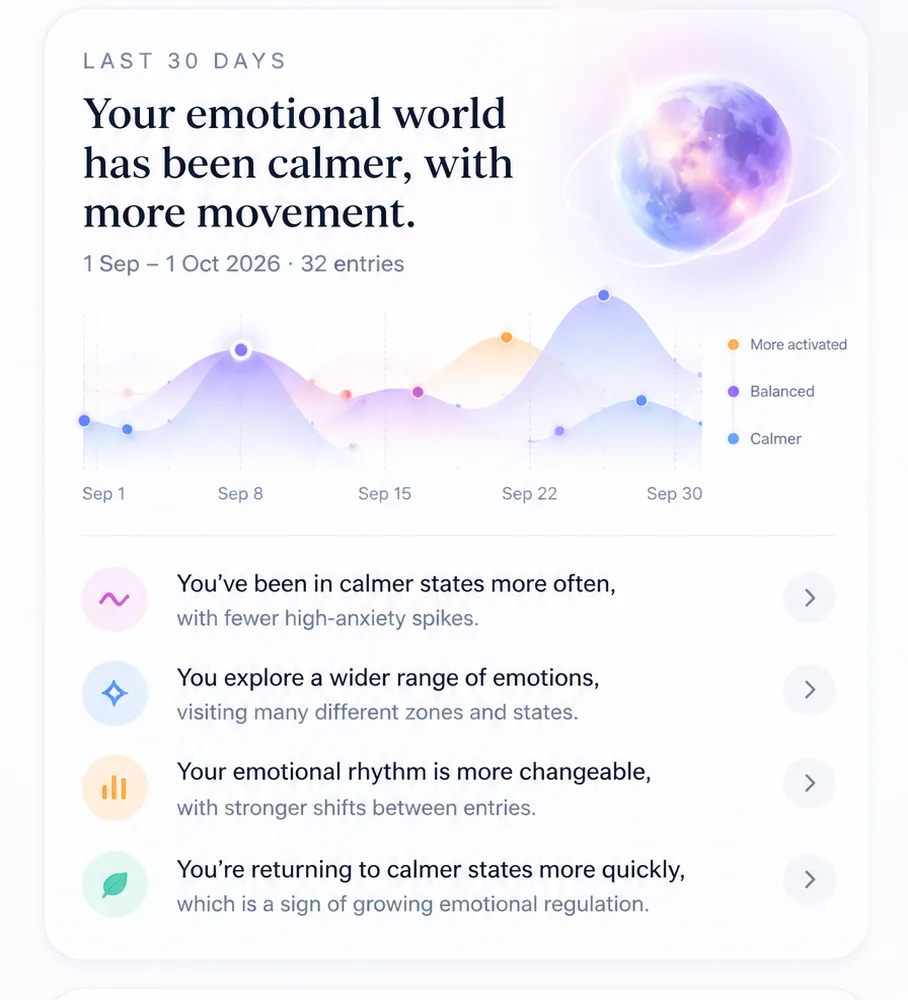
Week by week, month by month: which feelings keep returning, which show up together, and which words you keep writing. 'Disappointed and tired have been showing up most' is the kind of sentence you stop being able to ignore.
Next in the beta: the same patterns by person and situation.
THE EVIDENCE
Why a record changes things.
Naming helps.
Putting a feeling into words — affect labeling — is one of the simplest ways to take the edge off it. Research led by Matthew Lieberman at UCLA showed the effect in the brain; later studies showed it outside the lab. Not a cure. A handle.
Patterns beat memory.
Pressure works because memory blurs. Six weeks of short entries do what no single conversation can: they show what keeps happening.
A dated log is what experts advise.
Acas in the UK and the DGUV in Germany tell people dealing with bullying to keep a dated log; German courts accept a coherent diary as supporting evidence. Emotion OS makes that habit take 20 seconds instead of 20 minutes.
- Lieberman et al., Psychological Science 2007
- Acas, Being bullied at work
- DGUV Forum, Mobbing am Arbeitsplatz
We don't claim more than this. Emotion OS is a tool for clarity, not a treatment.
STATUS
Private beta, built in the open.
The beta answers one question: do people come back for 30 days, and does the pattern view show them something they didn't already know? Everything else — patterns by person, reminders, a native app — waits for that answer.
- 50
- testers in the private beta
- 3
- ways to capture: speak, swipe, tap
- 30 days
- the retention test we're running before anything else
BOUNDARIES
What Emotion OS is not.
It doesn't diagnose anyone. Not you, not the people in your life. It records your state, not someone else's personality.
It doesn't replace therapy or professional help. If you're in therapy, it can support the work between sessions.
It doesn't analyse your voice. Voice is transcription. What matters is what you said, not how it sounded.
It isn't a substitute for safety. If you're in immediate danger, contact local emergency services.
Entries belong to the person who made them. Nothing is shared with employers, partners or anyone else. Built for the EU: privacy by design, consent before anything is stored.
OPEN DOORS
Three kinds of people I want to hear from.
Testers
You're in a relationship — at work or at home — that leaves you doubting yourself, and you'd use a 20-second record for 30 days.
Practitioners
You're a therapist, coach or HR professional and you want to tell me where this helps and where it's wrong.
Partners and investors
You see the same gap — clarity tools for difficult relationships, built for the EU — and want to be part of it early.
Why I'm building this.
I spent twenty years inside large organisations. I've seen what pressure, hierarchy and unclear communication do to capable people — and how rarely anyone keeps a record of it. I understand the problem best from inside organisations; the pattern is the same at home. Emotion OS is the tool I wanted and couldn't find.
 Raoul J. Zénon